Sticky Purple Salvia is a potent herbal extract derived from Salvia divinorum, a perennial mint native to Oaxaca, Mexico. Often called Sticky Purple Salvia or Purple Sticky Salvia, this product is essentially a concentrated salvia leaf preparation. Traditional Mazatec healers in Oaxaca have used S. divinorum in spiritual and healing rituals, and in modern times it’s become popular among herbal enthusiasts and ethnobotany students for its vivid, short-lived psychoactive effects. This guide explains what Sticky Purple Salvia is, how it works, its uses, potential benefits, safety considerations, and other key facts.
- Plant origin: Sticky Purple Salvia comes from Salvia divinorum, a rare mint-family herb endemic to the highlands of Oaxaca.
- Active compound: Its effects are due to salvinorin A, a highly potent psychoactive diterpene.
- Product forms: It’s available as dried leaves, tinctures, or extracts (“5X, 10X, … 100X”) often labeled as Sticky Purple or Purple Sticky Salvia.
- Usage: Traditionally chewed or used fresh; today it’s most often smoked or vaporized. Doses are very small e.g. ~0.2 g of a 10X extract.
- Effects: Smoking Sticky Purple Salvia produces rapid-onset hallucinations (bright colors, distortions, dream-like imagery) lasting only a few minutes.
- Potential benefits: Research suggests anti-pain and anti-addiction properties in animals. Users also report introspective or mood effects, though evidence is anecdotal.
- Safety: Adverse effects can include panic, confusion or dizziness. It is not considered physically addictive, but should be used with caution.
- Legal status: Not scheduled federally in the U.S. (though banned in many states). It’s illegal or restricted in numerous countries. Always check local laws before purchasing.
What is Sticky Purple Salvia?
Image: Sticky Purple Salvia leaves (Salvia divinorum). This herb has broad, velvety green leaves with serrated edges. Sticky Purple Salvia simply refers to a concentrated extract of Salvia divinorum. Salvia divinorum (often called diviner’s sage or Seer’s Sage) is a perennial shrubby herb in the mint family, endemic to the cloud forests of Oaxaca, Mexico. Mazatec shamans have long used fresh S. divinorum leaves for divination and healing. In recent decades, however, S. divinorum became known outside Oaxaca as a “legal” psychoactive plant, sold under names like Sticky Purple Salvia or Purple Sticky Salvia.
In botanical terms, Sticky Purple Salvia is not a different species it is Salvia divinorum. The term “sticky” or “purple” refers to the appearance of the extract or branding. Sticky Purple Salvia products often contain salvia leaf mixed with a purple-colored extract or resin to indicate potency. Under the microscope, S. divinorum leaves contain tiny trichome glands filled with salvinorin A, a unique psychoactive molecule. Salvinorin A is exceptionally potent: it is active at doses as low as 200 micrograms, making Salvia divinorum one of the most powerful naturally occurring hallucinogens known. In fact, the effective dose of salvinorin A is comparable to that of LSD.
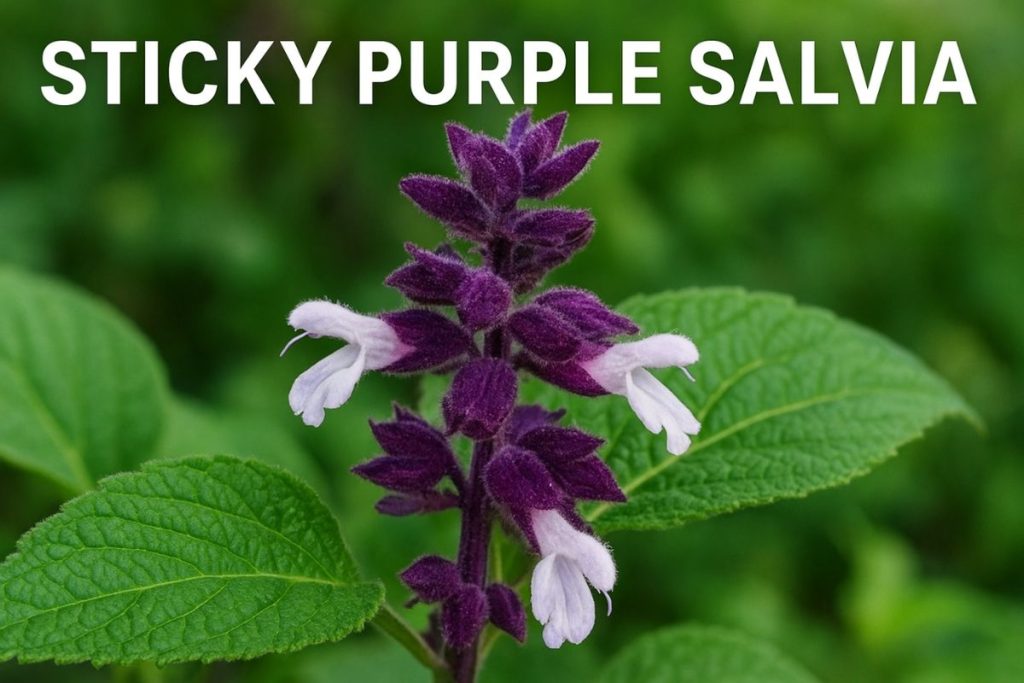
Key plant facts: S. divinorum is a 0.5-1.5 m tall shrub with hollow square stems and opposite, ovate-lanceolate leaves. It thrives in humid, shaded areas (cloud forests at 300-1800 m elevation) along streams. The leaves have a soft, slightly hairy surface and are mid to bright green. When it does flower (rarely, especially in cultivation), it produces small white flowers in clusters. The flower petals are white, surrounded by a distinctive violet-blue calyx, as shown below.
Botanical Profile and Habitat Sticky Purple Salvia
Image: Flower of Salvia divinorum (Sticky Purple Salvia). When it blooms, the plant displays delicate white flowers in a violet-blue calyx. Salvia divinorum grows naturally in the Sierra Mazateca of Oaxaca. Its best-known habitat is in shaded, mossy forests near streams, where humidity is high and light is filtered by the canopy. The plant does not set viable seeds, so it reproduces mainly by layering (broken stems taking root) or vegetative cuttings. In cultivation, growers propagate S. divinorum by cuttings since flowering is rare and seed fertility is nearly zero.
Active Components and Effects
Sticky Purple Salvia’s effects come from its chemical constituents, primarily salvinorins. The most important is salvinorin A, a neoclerodane diterpene present at roughly 0.18% of the dried leaf mass. Unlike most psychoactive plant compounds, salvinorin A contains no nitrogen it’s not an alkaloid. It works as a highly selective kappa-opioid receptor (KOR) agonist, which leads to dissociative and hallucinogenic effects.
By mass, salvinorin A is more potent than any other naturally occurring hallucinogen. For perspective, LSD is active at 20–30 micrograms, whereas salvinorin A’s activity threshold is around 200 micrograms. This extreme potency means very small doses are needed. (For example, 200 µg of salvinorin A in a 20× extract would correspond to about 0.01 g of extract.) Despite this potency, animal studies show it has relatively low toxicity rodents given extremely high doses showed no long-term organ damage.
Effects on mind and body: Smoking Sticky Purple Salvia leads to rapid-onset effects (seconds) that peak within minutes and wear off typically in 5–15 minutes. Users often report vivid sensory changes: bright colors, geometric patterns, altered sense of space and body, out-of-body sensations, and dream-like visions. Some describe intense introspective or spiritual feelings; others feel disoriented or frightened. Physical effects can include loss of coordination, dizziness, and a heavy or floating body sensation. The experience is very short-lived compared to classic psychedelics. If inhaled properly, the peak can come and go in under 10 minutes. Unlike LSD or psilocybin, which act on serotonin receptors, salvinorin A’s KOR activity makes its effects unique and often described as dissociative.
Because of its novelty, researchers are exploring potential therapeutic uses of salvinorin A. Preclinical studies have found analgesic (pain-relief) and anti-inflammatory effects. In mice, S. divinorum extracts significantly reduced pain behaviors, an effect blocked by opioid antagonists. Animal models also suggest salvinorin A might curb addiction and offer neuroprotection. However, human data are very limited. To date, no controlled clinical trials have proved medical benefits, and no use is FDA-approved.
Traditional and Modern Uses Sticky Purple Salvia
- Traditional rituals: Salvia divinorum has a long history of ceremonial use among Mazatec shamans. They use fresh leaves in quiet settings for visionary experiences intended for divination or healing. The Mazatecs regard the plant as sacred, often calling it “La Maria” (Mother Mary) during rituals. Traditional use is typically infrequent and controlled.
- Folk medicine: In Oaxaca, small amounts of the herb have been used as a herbal remedy for example as a mild diuretic or to treat headaches, diarrhea, and rheumatism. These medicinal uses involve low doses (e.g. a single leaf) chewed slowly or brewed as a tea. Modern science has not fully validated these treatments, but ethnobotanical surveys note these folk applications.
- Recreational/highway use: In the late 1990s and 2000s, Salvia divinorum became popular globally as a “legal high.” Vendors began selling dried leaves and concentrated extracts in novelty shops and online. Sticky Purple Salvia is one such product aimed at consumers seeking a stronger effect. People typically smoke or vaporize extracts for a brief but intense trip. For many, salvia is a curiosity rather than an everyday drug. In 2008, U.S. surveys found about 1.8 million Americans aged 12+ had tried salvia at least once, reflecting its relative popularity.
- Research interest: Modern science views salvinorin A’s unique pharmacology as potentially useful. Researchers are studying salvia derivatives for treating pain, addiction (e.g. cocaine dependence), depression, and stroke. The idea is to harness its kappa-opioid effects without full psychoactive intensity. However, rushed legislative bans have made research difficult.
Product Forms and Dosage Sticky Purple Salvia
Sticky Purple Salvia is sold in several forms: dry leaf, pre-packaged leaf blends, tinctures, or extracts. The leaf is typically cut into small pieces or crushed. Extracts are made by soaking leaves in solvent, collecting salvinorin-rich resin, and sometimes adding a colorant. Products will be labeled with potency multipliers (e.g. “10x” means one gram of extract equals 10 grams of plain leaf). Notably, sticky purple or purple sticky branded extracts often use a purple-tinted resin for marketing.
- Leaf vs. extract: Raw S. divinorum leaf yields only mild effects unless many grams are used. Concentrated extracts (branded Sticky Purple Salvia, Purple Sticky, etc.) deliver much stronger effects in tiny amounts. For example, a 10X extract dose is about 0.2 grams (200 mg), while a 50X extract dose can be as little as 0.04 grams (40 mg). (As a rough guide, a pure salvinorin A dose around 200 µg corresponds to 0.04–0.05 g of a 50X extract.) One product marketed as “Purple Sticky Salvia 100x” would require only 0.02 g for an active dose, so accuracy is crucial. Note: Some online forums warn that branding like “100X” can be exaggerated, so start with even smaller amounts than labeled.
- Administration: The fastest way to activate salvinorin A is by smoking or vaporizing dry leaf or extract. Users often place the herb on foil or in a pipe or bong and inhale deeply with a torch or intense flame, then hold the breath for 15–30 seconds. Standard practice is to exhale and wait a moment between hits. Effects appear almost immediately after inhalation. Alternatively, traditional methods involve chewing a fresh leaf quid and holding it in the mouth (sub-lingual absorption), which produces a milder, more gradual effect lasting up to an hour. Some people also make alcohol tinctures or encapsulate extracts, but oral bioavailability of salvinorin A is poor (it’s mostly inactive if swallowed).
- Dosing: Always measure doses precisely. Never eyeball extracts or exceed a recommended dose on first try. A common beginner dose is a fraction of a 10X extract (e.g. 50–100 mg) or a few tens of milligrams of a 50X+ extract. Salvinorin A’s potency is such that taking much more can cause overwhelming experiences. Because extracts vary, it’s safer to start ultra-low, see how it feels, and increase gradually on separate occasions. By contrast, eating 1–2 grams of plain leaf usually produces little to no psychedelic effect.
Usage tip: Keep the setting safe and calm. Due to its intense but brief action, many users lie down or have a sitter nearby. Avoid smoking Sticky Purple Salvia if alone in a dangerous environment (heights, water, traffic).
Potential Benefits and Research Findings
While Sticky Purple Salvia is mostly used for its psychoactive “trip,” there is growing interest in medicinal possibilities. Preclinical research has identified several potential effects:
- Pain relief: Both traditional accounts and lab studies support analgesic properties. In fact, Salvia divinorum has a history of use for pain and headaches. Modern experiments show that salvia extracts produce strong pain inhibition in rodents, comparable to opioids. The effect is dose-dependent and reversible by naloxone (an opioid blocker), indicating opioid receptor involvement.
- Anti-addiction: Some animal studies suggest salvinorin A might reduce cravings or withdrawal for substances like cocaine and morphine. The exact mechanisms are not fully understood, but KOR agonists are known to modulate dopamine pathways.
- Anti-inflammatory: In lab models of injury, salvia compounds showed anti-inflammatory and neuroprotective effects. This could link to pain relief in tissues.
- Mood effects: There are mixed findings. Some low-dose studies hint at short-term antidepressant-like effects, but others note dysphoric or anxiogenic outcomes. Salvia’s action on KORs can lead to both sedation and dysphoria, depending on dose and context.
Importantly, no pharmaceutical claims are approved. All these findings come from animal or cell studies, not controlled human trials. The DEA notes that Salvia divinorum and salvinorin A have “no approved medical use in the United States”. Until more research is done, any health or wellness benefits remain speculative. Consumers should view Sticky Purple Salvia strictly as an experimental botanical, not as a certified therapy.
Risks, Side Effects, and Safety Tips Sticky Purple Salvia
Like any potent substance, Sticky Purple Salvia carries risks and side effects. The DEA Drug Fact Sheet and other sources highlight:
- Psychological effects: Users can experience extreme confusion, anxiety, or fear. Hallucinations are often disorienting; panic attacks and paranoia have been reported. Some individuals laugh uncontrollably or cry. Set and mindset matter greatly. If you feel uncomfortable, remember the effects fade quickly (usually within 10 minutes).
- Physical effects: Salvia use may cause dizziness, lack of coordination, and slurred speech. Nausea or gastrointestinal discomfort is also possible. There is a small risk of accidents (falls, injuries) during the short trip. The Washington Post notes that drive on salvia can be dangerous, as it severely impairs perception.
- Toxicity: Long-term toxicity seems low. Research indicates no evidence of organ damage in animal studies. Emergency rooms have not seen significant salvia overdoses. In fact, one researcher states, “Salvia doesn’t appear to be addictive, nor is it particularly toxic. The science is pretty clear… Salvia is not the next methamphetamine or the next cocaine or heroin.”. However, this does not mean it’s harmless the acute psychological impact can be strong.
- Dependency: No known physical dependence or withdrawal syndrome exists for salvia. However, psychological habituation is possible if someone uses it frequently for escape. Responsible use means not making it a daily habit.
- Interactions: The safety of using Sticky Purple Salvia with other drugs (alcohol, prescription meds, etc.) is unknown. Combining substances can increase risks (e.g. stronger anxiety or nausea). It’s best to avoid mixing.
- Legality and purity: Because salvia is legal in some places, products are unregulated. This raises concerns about purity and accurate labeling. For example, Washington Post reports street vendors selling “Purple Sticky Salvia” at beachside shops. Such products may not disclose actual potency or ingredients. Only purchase from reputable sources with quality standards.
Safety tips: Always use Sticky Purple Salvia in a calm, comfortable environment, ideally with a sober sitter present. Start with a very low dose and wait at least 15–30 minutes before re-dosing (which is often unnecessary given its intensity). Do not drive, swim, or operate machinery after use. Keep it away from pets and children. If you have a personal or family history of mental illness (e.g. schizophrenia, bipolar), avoid potent psychedelics like salvia, as they could worsen underlying issues. Pregnant or nursing women should avoid it entirely (salvinorin’s effects on pregnancy are unknown).
Usage Guidelines and Dosage Sticky Purple Salvia
- Measure carefully: Use a milligram scale for extracts. A tiny scoop from a vial can easily exceed the desired dose.
- Initial dose: If using a 10X extract, start around 100–200 mg (0.1–0.2 g). For a 20X or higher, start below 50 mg. Modern sources sometimes sell 100X extracts; such a dose could be as low as 20 mg or less approach with extreme caution.
- Method: Pack the measured extract into a pipe or vaporizer. Use a torch lighter for immediate heat. Inhale fully and hold for ~20 seconds. Exhale and wait 5–10 minutes to feel effects. If nothing happens, you may try a bit more, but do so slowly.
- Alternative: Chew-and-hold: Place a small fresh leaf or a tiny pinch of extract in the mouth and keep it against the cheek/gums. Salvinorin absorbs sublingually. This method yields a gentler, longer experience (up to an hour), useful if smoked trips are too intense.
- Wait times: Effects peak quickly; do not re-dose immediately. If you wish to increase, wait at least 30 minutes and start with only 50% of your original dose.
- Environment: Use Sticky Purple Salvia in a familiar, safe setting. Avoid heights or water in case of loss of balance. Having a friend around is wise.
Remember that “more is not always better.” With salvia, a small extra dose can mean a vastly deeper trip. Always err on the side of less.
Legal Status Sticky Purple Salvia
The legality of Sticky Purple Salvia depends on your jurisdiction:
- United States (Federal): As of 2025, Salvia divinorum and salvinorin A are not scheduled under the federal Controlled Substances Act. This means they are not illegal at the federal level. However, the DEA has called salvia “a drug of concern” and has proposed scheduling in the past.
- United States (State laws): Despite no federal ban, many U.S. states have enacted laws restricting salvia. Over a dozen states have made it Schedule I, II, or III, similar to LSD or marijuana. Some states ban possession or sale outright, others limit age or form. Always check your state’s current laws.
- International: Numerous countries regulate S. divinorum. For example, it is illegal in the UK, much of Europe, Australia, and parts of Asia. In Europe, it may fall under analogue or psychotropic laws. Some countries allow possession but ban sale. Due to changing laws, consult local regulations or legal advice before ordering.
Legal status can change, so stay informed. Never assume legality. If in doubt, treat it with caution or avoid acquiring it.
Encouraging Safe Use and Dialogue
Sticky Purple Salvia is a powerful ethnobotanical substance. While it has intrigued many, it should be approached with respect and knowledge. Education is key. If you choose to experiment, keep the focus on safety and informed decision-making. Start slow, surround yourself with trusted people, and know that the effects are temporary.
We hope this guide has answered your questions about Sticky Purple Salvia. Share it with fellow herbal enthusiasts and students of ethnobotany. If you have personal experiences or additional insights, please comment below. Engaging with a community helps everyone learn.
Disclaimer: This article is for informational purposes only. Sticky Purple Salvia (Salvia divinorum) use can involve legal and health risks. Consult qualified experts for personal advice, and obey local laws.
Frequently Asked Questions (FAQs)
What is Sticky Purple Salvia?
Answer: Sticky Purple Salvia is a concentrated extract of Salvia divinorum, a psychoactive mint native to Mexico. The name refers to how the product looks (often a sticky, resinous extract dyed purple). Its active ingredient is salvinorin A, which causes short but intense hallucinogenic effects. It is essentially the same herb known as diviner’s sage or purple sticky salvia.
What is purple sticky salvia?
Answer: Purple Sticky Salvia is simply another name for Sticky Purple Salvia. These terms are often used interchangeably in the herbal products market. They indicate a Salvia divinorum preparation that is strong (often an extract). Brand names like “Purple Sticky Salvia™” exist, but in general usage, “purple sticky salvia” means a potent salvia product similar to Sticky Purple Salvia.
How is Sticky Purple Salvia used?
Answer: It is most commonly smoked or vaporized. People inhale the fumes of dried leaves or resin. Some traditional users chew the fresh leaf and hold it in the mouth. The smoking route delivers salvinorin A quickly to the brain for a rapid effect. Other forms include tinctures or capsules, but these are less common since salvinorin A is poorly absorbed by simply swallowing.
What are the effects of Sticky Purple Salvia?
Answer: Inhaled Sticky Purple Salvia typically causes an almost immediate trance-like experience. Effects include vivid visual hallucinations (bright lights, geometrical shapes), body distortions, a sense of teleportation or “ego loss,” and dream-like scenarios. The trip is intense but short (typically 5–15 minutes). Afterward, normal perception returns. Some users feel deep introspection or creativity during the experience. Negative effects can include confusion, panic, or disorientation.
Are there any benefits to using Sticky Purple Salvia?
Answer: Some people use it for the novel experience and personal insight. Preliminary scientific studies suggest salvia extracts may relieve pain and reduce inflammation. Research is also investigating potential benefits for addiction or neurological conditions. However, these potential benefits are unproven in humans. Any therapeutic claims are still experimental. Traditional healers use it occasionally for ceremonial healing, but modern “beneficial” uses have not been clinically validated.
Is Sticky Purple Salvia safe?
Answer: When used responsibly, salvia is often considered relatively low-risk compared to addictive drugs. It has not been linked to organ damage or compulsive addiction. However, it can cause acute fear or paranoia in some people. Always use it in a safe environment and never while driving or operating machinery. Because purity varies, only get products from trusted sources. Those with mental health conditions should avoid it. In summary: it’s not “safe” in the trivial sense, but with precautions it’s much less risky than many illicit substances.
Is Sticky Purple Salvia legal?
Answer: Legality varies. In the U.S. federal law it is not controlled, but many states have banned salvia. Internationally, it is banned or restricted in many countries. Always verify local laws before purchasing or possessing salvia. Remember: even where it’s legal, selling it with therapeutic claims can be illegal.
How is Sticky Purple Salvia different from Purple Sticky Salvia?
Answer: They are the same product with reversed words. Both terms refer to the same concentrated Salvia divinorum extract. The reversal of “purple” and “sticky” is simply a branding or colloquial variation. Some product lines use one name or the other, but chemically there’s no difference just based on the name.
What is Sticky Purple Salvia 100x?
Answer: “100x” denotes an extremely strong extract (100 times the potency of plain leaf). So Sticky Purple Salvia 100x would be a highly concentrated form. Only very small doses (tens of milligrams) are needed. If you encounter something labeled Purple Sticky Salvia 100x, assume it’s very powerful and use an extremely small amount. Dose guidelines (like those from NACCHO) give examples: ~0.2 g for 10x, 0.08 g for 25x, 0.04 g for 50x, so a 100x dose might be in the 0.02–0.03 g range.
What precautions should I take?
Answer: Use a measured dose, have a sober sitter, and be in a safe place. Start with much less than you think, because this herb is potent. Do not mix with alcohol or drugs. After inhaling, stay seated or lie down until fully recovered. Stay hydrated. If negative effects occur (severe panic or discomfort), remember they will fade rapidly. Discuss any concerns with a knowledgeable herbalist or health professional.
Citations: Authoritative sources have been cited throughout (DEA, peer-reviewed studies, ethnobotanical records) to support this information. Always consult the original sources for more detailed study.
Previous Post: Medvice Hot Cold Pack, Lower Denture Implants, Hip Pain Postpartum, White Gold Grillz