
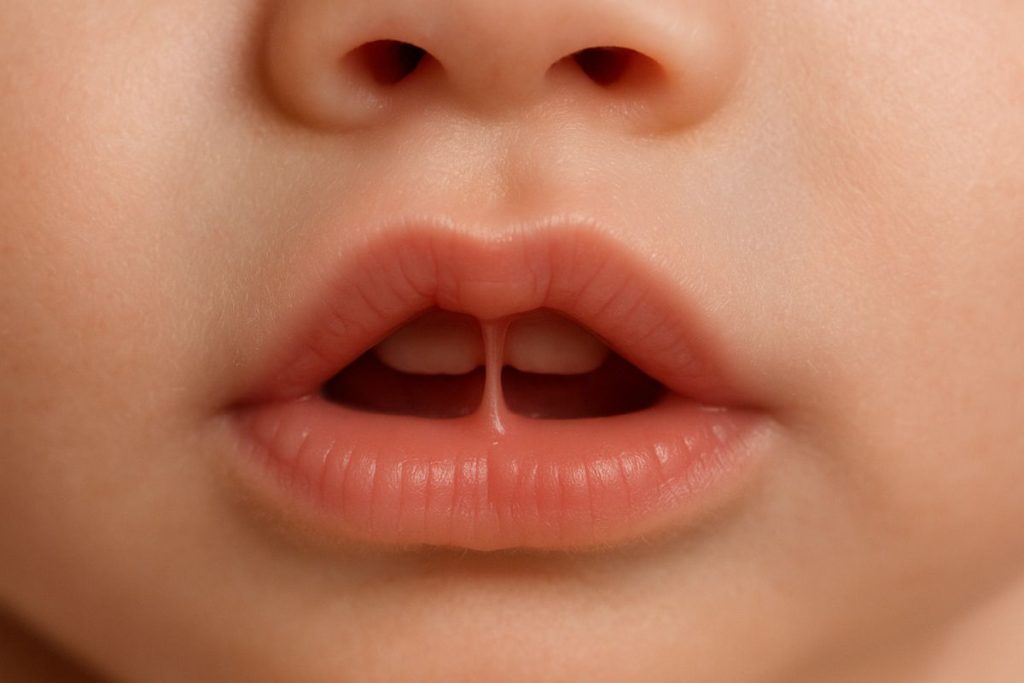
A lip tie occurs when the labial frenulum (the small fold of tissue under the upper lip) is unusually tight, thick, or short. This tissue connects the upper lip to the gum, and if it restricts lip movement, an infant may have trouble latching properly.
A lip tie (also called an upper lip tie or top lip tie) is less common than the similar tongue tie, but it can still make breastfeeding or bottle feeding difficult. Left unrecognized, babies with lip tie often take in extra air, leading to gas and colic.
The good news is that once identified, a lip tie is usually easy to fix. In this article we explain what a lip tie looks like, how to recognize symptoms in infants and toddlers, and the latest treatment approaches (including frenectomy for lip tie).
What Is a Lip Tie?
Every baby’s mouth has a labial frenulum a thin band of tissue that attaches the upper lip to the gum. A lip tie happens when this frenulum is so thick or short that it limits the normal movement of the lip. In other words, the upper lip cannot flange outward as usual. By contrast, a normal frenulum (often just called labial frenulum) usually lets the lip move freely and often stretches or migrates up as a child grows.
Lip ties are sometimes graded by attachment type (Kotlow classification): Class 1 (minimal restriction at the lip margin), up to Class 4 (frenulum tightly attached high on the gum). A Class 1 frenulum is typically not problematic, whereas a Class 3 or 4 can restrict lip mobility. However, attachment type alone doesn’t guarantee symptoms it’s the functional restriction that matters. In fact, many infants with “low set” frenula have no issues at all.
Only when the tight frenulum prevents the lip from flanging (opening wide) do doctors label it a lip tie. It’s worth noting that a tight upper lip tie can contribute to spacing between the front teeth (a midline gap) and even make brushing the front teeth harder, since debris may get trapped under the lip.
Signs & Symptoms of Lip Tie in Babies
Lip ties can manifest subtle symptoms or make feeding noticeably difficult. Watch for these common signs in infants and toddlers:
- Breastfeeding difficulties: The baby struggles to latch onto the breast, takes an unusually long time to feed, or frequently slips off the nipple. You may also hear a soft click as air breaks the seal during nursing.
- Feeding fatigue: The baby tires quickly at the breast or bottle, often falling asleep shortly after starting feeding. Babies may seem unsatisfied and fussy at the breast.
- Poor weight gain: Because feeding is inefficient, infants with a significant lip tie sometimes gain weight slowly or appear constantly hungry. Monitor growth charts closely.
- Excessive gas or colic: A lip tie can cause a baby to swallow extra air, leading to gassiness, spitting up, or colic symptoms.
- Maternal discomfort: If breastfeeding, mothers often feel pain during nursing or notice nipple damage. Breasts may feel painfully engorged even after feeding, or you may get plugged ducts or mastitis from ineffective drainage.
- Oral indicators: On examination, you might see a notch or blanching of the gum under the lifted lip, suggesting a tight frenulum. Also observe whether the baby’s upper lip flares out when lifted it should. If the center of the lip stays anchored or the gums turn white (blanch) under tension, that’s a clue to a lip tie.
If any of these symptoms occur, it’s wise to have your baby evaluated by a pediatrician, dentist or IBCLC (International Board Certified Lactation Consultant). Early recognition of a lip tie baby can spare weeks of difficult feedings.
Lip Tie vs. Normal Frenulum (with Pictures)
All babies have a labial frenulum, so how do you tell a lip tie from a normal frenulum? The difference lies in function, not just appearance. An infant with a truly normal frenulum will exhibit full, flexible lip movement. When the upper lip is gently lifted, the lip should flange (roll outward) smoothly, and the gum should not blanch white.
According to pediatric experts, a frenulum that reaches the gums or palate does not automatically indicate a lip tie. In fact, a study of over 1,000 newborns found 94% had low frenulum insertions yet most fed normally. The key test is function: if breast or bottle feeding is comfortable and effective, a tight appearing frenulum may still be benign. If problems do exist, a professional exam will assess range of motion. A white blanch on the gums when the lip is lifted (shown in some of the pictures above) means the frenulum is under tension. Likewise, a visible notch in the gum bone at the attachment site signals significant restriction.
Diagnosing a Lip Tie
If you suspect a lip tie, start with a feeding evaluation. Breastfeeding difficulties or a poor latch should prompt professional help. Lactation consultants (IBCLCs) and pediatricians are trained to examine the mouth during feeding. During the exam, the specialist will gently lift the baby’s upper lip and observe how it moves and how feeding progresses. If lip tie or tongue tie are suspected, pediatric dentists or ENT specialists can make a quick diagnosis.
In many cases, diagnosis is made when an infant struggles to nurse. The doctor will note any feeding compensation: for example, does the baby manage by tucking the lip, repeatedly unlatching, or making a clicking sound? They will check both tongue and lip mobility because many infants with a true lip tie also have a tongue tie. It’s generally advised that an IBCLC assessment precede any surgical consideration: a skilled consultant can confirm whether feeding issues are truly due to anatomy, not just latch technique or positioning.
Feeding Challenges and Lip Tie
In the meantime, you can try some strategies to improve your baby’s intake. Often, bottle feeding or pumped breast milk will be easier for a baby with a lip tie. Milk from a bottle doesn’t require the same seal as nursing, so your baby may take in more volume. If you pump and bottle feed, remember to pump at every feeding you supplement so you don’t lose supply.
If you wish to continue nursing, lactation consultants recommend a few tricks:
- Optimize latch: Try different breastfeeding positions. For instance, a laid back or football hold may give the baby a better angle to latch deeply.
- Prepare the breast: Some moms find that letting the baby nurse on one breast for a moment, letting the saliva soften the nipple, then switching, can help.
- Frequent breaks: Pause to burp baby more often; swallowing less air can reduce discomfort.
- Professional help: An IBCLC can demonstrate techniques like applying gentle pressure to help the breast flange. These experts sometimes teach exercises, such as sliding a finger under the baby’s lip and working the tissue, to gently stretch it.
Overall, paying attention to feeding cues and keeping track of wet diapers and weight gain helps determine if the baby is getting enough nutrition.
Treatment Options for Lip Tie
Most mild lip ties need little intervention the baby’s mouth often adapts, or the frenulum stretches as teeth come in. For minor cases (Kotlow Class 1 or 2) without symptoms, doctors usually recommend observation and possibly tongue/lip stretching exercises at home. These exercises (like gently tugging the lip or massaging the frenulum a few times a day) may slowly improve mobility.
When a lip tie causes significant feeding problems, the standard solution is a frenotomy (also called frenectomy) a simple procedure to snip the tight tissue. This is typically done by a pediatric dentist or pediatrician. In practice, a thin sterilized surgical scissor or laser is used to release the frenulum. Most infants tolerate this very well research and breastfeeding experts report that the baby feels little or no pain and no anesthesia is usually needed.
In some clinics, if both tongue and lip ties are present and both are impeding feeding, doctors may release both in one visit. Otherwise, if only an upper lip tie is severe (Kotlow Class 3 or 4), a single frenectomy on the lip is performed. The procedure takes only seconds to do. Because it’s quick and healing is fast, it has become a common fix: “A labial frenectomy can result in significant improvement in breastfeeding outcomes,” according to surgical literature. Indeed, one 2017 study of over 200 infants found that releasing tongue and lip ties together greatly improved feeding almost immediately.
Frenectomy Procedure and Recovery
During a frenectomy for a lip tie, the area is usually numbed with topical or local anesthetic (depending on age and severity). A laser or surgical scissors quickly snip the frenulum, releasing the tension. Parents are often encouraged to breastfeed or bottle feed immediately afterward to promote comfort and oxygenate the wound.
Recovery is generally rapid. Babies may have slight irritability or swelling around the upper lip for a day or two, but pain is minimal. Because the cut in a frenectomy is so small, it often heals as fast as a paper cut. By about 24-48 hours, the frenulum usually re forms as a soft line of tissue rather than a rigid band.
To ensure the frenulum doesn’t re attach tightly, doctors will teach you simple exercises: after feeds, gently massage or swipe a clean finger under the lip and along the gum line (sometimes called “roll the lip”). Performing these lip stretches a few times daily for the first week prevents scar tissue from pulling the lip back down. Many providers refer to external guides or videos for parents for example, pediatric dentists provide aftercare instructions with pictures.
After a successful frenectomy and diligent stretching, most infants show immediate improvement: latch becomes deeper, feeding time shortens, and mothers report far less pain.
Lip Tie in Toddlers and Older Children
By toddlerhood, babies outgrow some feeding issues but a tight lip frenulum can still cause concerns. Some toddlers may have trouble drinking from a cup or eating with a spoon if their upper lip won’t flange normally. Orthodontists sometimes note a persistent gap between the two front teeth (midline diastema) in children with untreated lip ties. In some older kids, a severe upper lip tie may contribute to speech difficulties (certain sounds like “p”, “b”, “m” need lip movement).
For example, one pediatric dental source notes that lip ties can indirectly lead to orthodontic issues or even dental decay down the road. A tight lip tie might trap milk or food debris on the front teeth, raising the risk of cavities. Some children with a lip tie also exhibit speech or oral posture compensations (like tucking the lip under teeth). However, true functional problems in toddlers are less common; many adapt well. If concerns arise (for speech or dental reasons), a pediatric dentist or orthodontist can assess whether a lip tie may need release even at older ages.
Complications and Long Term Effects
Generally, lip ties are benign if they don’t interfere with feeding. “Lip ties don’t have as many complications later in life,” health experts note. The most frequently cited long term issues are orthodontic: a small gap between the front teeth or a tendency toward early plaque buildup on the upper incisors. Pediatricians also warn that an untreated lip tie could slightly raise a child’s risk of tooth decay in the upper front teeth, presumably because of plaque traps under the frenulum.
Some believe untreated upper lip ties might contribute to mild speech or eating pattern issues, but evidence is limited. Most children with minor lip ties grow up fine. The real takeaway is prevention: if a lip tie is causing ongoing feeding stress or oral health concerns, it’s worth treating early. Once corrected, the upper lip usually functions normally, and long term problems from the lip tie itself almost never occur.
Lip Tie and Tongue Tie
It’s very common for babies to have both a lip tie and a tongue tie. In fact, a true isolated lip tie is rare. Lactation specialists report that in the vast majority of cases where a lip tie is treated, a tongue tie is also present. This is why many pediatricians assess both at the same time. If a child has difficulty feeding and only the lip is released, any residual tongue restriction can still cause trouble.
It helps to understand the difference: a tongue tie (ankyloglossia) tethers the tongue’s tip and limits how far it can extend or elevate. A lip tie tethers the upper lip. Both can affect latch tongue tie by not allowing the baby to cup or press the breast deeply, and lip tie by not letting the lip seal fully. When both ties exist, doctors often recommend releasing both (a “tongue and lip tie revision”) to maximize improvement. Research suggests that releasing both ties, when indicated, leads to the best outcomes in breastfeeding success.
When to See a Doctor
If feeding is painful, baby has low weight gain, or you notice the tell tale signs above, consult your pediatrician or a pediatric dentist. Even if weight gain is adequate, persistent feeding frustrations are a clue. An upper lip frenulum check is a simple part of a well baby exam; don’t hesitate to ask your doctor to examine it if you have concerns. Lactation consultants can also identify lip and tongue restrictions during a feeding consultation. Early action (in the first weeks or months) is easiest, but even older infants and toddlers can benefit from release if they’re symptomatic.
Key Takeaway: A lip tie can make nursing or bottle feeding challenging, but it is not difficult to fix. With proper diagnosis and a quick procedure (if needed), most babies feed normally and gain weight well. Keep in mind that breastfeeding should not be painful or overly exhausting. Always speak with your child’s pediatrician or a lactation specialist about any feeding problems.
FAQ
Q: What is a lip tie and how do I recognize it?
A: A lip tie is when the fold of tissue (frenulum) under the baby’s upper lip is unusually short or tight. You might notice the baby’s upper lip cannot easily roll outward. Common clues are feeding difficulties (painful latch, clicking noises) or a visible band of tissue that snaps the lip down when lifted. During an exam, lifting the baby’s lip causes the gums to blanch (turn white) if a lip tie is present.
Q: Can I see a lip tie in pictures or compare it to normal?
A: Yes. Pictures of lip ties show the upper frenulum stretching down to the gum, sometimes as a wide band. In contrast, a normal frenulum is very thin and sometimes hard to see unless stretched. The images above (and in many pediatric dentistry resources) illustrate this difference【13†】【14†】. If unsure, have a pediatric dentist assess it.
Q: Does a lip tie require surgery?
A: Not always. Many minor lip ties (especially Class 1 or 2) can be managed with monitoring or simple stretches. If the tie is causing feeding problems, the usual treatment is a quick procedure called a frenectomy or frenotomy. This literally cuts the tight tissue to release it. It’s generally a very safe, simple cut that heals quickly, often with minimal discomfort to the baby.
Q: Is a frenectomy safe and does it hurt the baby?
A: Frenectomy for lip tie is considered very safe. It’s often done with just a topical numbing gel or very little local anesthesia. Babies typically cry briefly during the cut but calm immediately afterward. Most experts report the baby actually feels less discomfort after the procedure, since feeding becomes easier. Women’s and children’s hospitals frequently use lasers or clamps to make the release ultra quick.
Q: Will my baby’s lip tie go away on its own?
A: A mild lip tie may become less noticeable as baby grows as the gums and teeth develop, the frenulum can stretch upward slightly. However, if it is causing symptoms, it’s unlikely to resolve enough on its own soon enough to ease feeding problems. In practice, if feeding is painful or ineffective, doctors do not wait for a lip tie to “go away” they offer stretching or a quick release.
Q: What problems can an untreated lip tie cause later?
A: Generally, untreated lip ties in babies do not lead to major health problems. Possible issues include a higher chance of tooth decay on the upper front teeth (due to trapped food) and a gap between the two front teeth (diastema). Some speculate there might be minor speech or feeding quirks later, but most kids adapt. The main reason to treat a lip tie is current feeding or dental concerns, rather than to prevent future problems.
Q: How common is a lip tie in newborns?
A: There’s no exact number, but lip tie is fairly uncommon compared to tongue tie. A landmark Swedish study found that while most infants have a low frenulum attachment, very few have a functionally problematic lip tie. In short, many babies have a short frenulum, but only a small number have a restrictive lip tie that needs attention.
Q: Can a lip tie affect bottle feeding or only breastfeeding?
A: Bottle fed babies might do slightly better since bottle nipples require less lip flanging than breast. However, a severe lip tie can still cause trouble with latch even on a bottle, and may also lead to some swallowing of air. It’s mostly recognized in breastfeeding because nipple pain in mom or poor latch there is so noticeable.
Q: Is a lip tie the same as being “lip tied”?
A: “Lip tied” is just another way of saying a baby has a lip tie. You might hear parents use “lip tied” to describe an infant who can’t flip the upper lip fully. It’s slang for the same condition.
Q: What is a ‘frenectomy for lip tie’?
A: A frenectomy (or frenotomy) is the treatment for a lip tie. It’s the procedure where the tight labial frenulum is cut. In most contexts, frenectomy for lip tie means the surgical release of the upper lip’s frenulum. It’s often done in a doctor’s or dentist’s office and usually takes less than a minute. The goal is simply to free the lip so normal movement and feeding can resume.
Q: Can lip ties cause weight gain problems in infants?
A: Yes, if they significantly hinder effective feeding. A baby who can’t latch well may not take in enough milk during nursing, leading to slow weight gain or failure to thrive. That’s why most practitioners focus on feeding outcomes: as long as the baby is feeding comfortably and gaining weight, a minor lip tie alone isn’t an emergency. If growth falters, then release is indicated.
Lip tie in babies and toddlers is a manageable condition once identified. By understanding the signs (poor latch, clicking, maternal pain) and seeking timely evaluation, parents can ensure their little one feeds well. Treatments like frenectomy are quick and often life changing for breastfeeding moms. If you have questions or concerns about infant lip tie, schedule an assessment with a pediatric dentist or lactation specialist proper guidance will set your child on the best path for feeding and growth.